
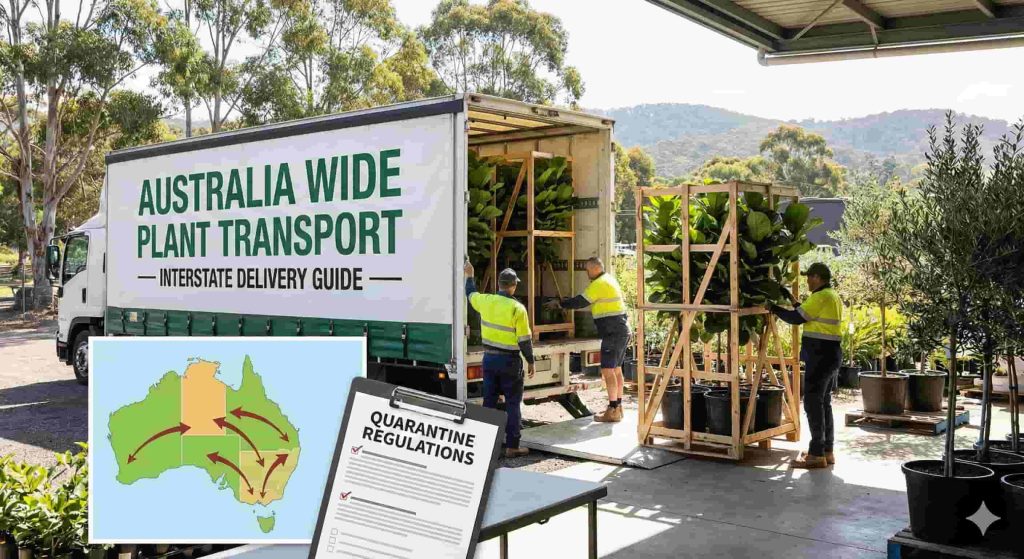
Do you know that Australia’s $3B nursery sector relies heavily on the plant delivery in the Australia corridor, which moves 28% of all east-coast stock, fueling rising demand for trusted live plant transport?
But it is unknown that moving live plants is not a cakewalk. Every detail matters, from packaging to temperature control to regulatory compliance.
This guide breaks down the steps involved in compliant live plant transport in Australia.
Live Plant Logistics Need Specialised Freight
Unlike general freight, live plants need more safety measures. Without the compliance, it can face –
- 42% higher risk of environmental stress
- 27% more handling-related damage events
- Greater biosecurity compliance obligations under state quarantine laws
These risks mean that growers must use a transport partner experienced specifically in live plant logistics, rather than generic freight carriers.
Steps Involved In Live Plant Transport Across Australia
To get what is expected, special compliance measures are required. Not all truck or freight services can guarantee the same. Whereas, trusted interstate freight management services like Freeman Freightlines can bring assurance in local haul movement.
Pre-Transport Assessment
Professional carriers use route-mapping systems, GPS-linked temperature logs, and load-pressure forecasting to minimise damage. Along the plant freight Sydney Brisbane route, this planning helps manage humidity drops typical during overnight travel over the Great Dividing Range.
The structure assessment includes –
- Understanding the plant species sensitivity (such as whether it is sensitive to heat, frost, and moisture)
- Knowing the pot dimensions and mass
- Reading the fragility of root systems, buds, leaves, and stems
- What are the pallet configuration, available spacing, and stacking restrictions
- Also, understanding the length of the trip and the weather along the way
Packaging & Containment System
The packaging is the most neglected point in interstate plant moves. Research conducted in Australian nurseries reveals that using specially designed Pallecon systems instead of generic pallets can reduce plant losses by up to 63%.
Further, Industry-Standard Packaging Adds:
- Pallecon systems for moisture retention, airflow, and stability
- Shelving that can be adjusted to avoid crushing leaves
- Ventilation-enabling protective wrap
- Supporting tall plants using a tie-down
- Inserts that stabilise pots to stop soil displacement
Temperature & Climate Control
Management of temperature and climate control is as important as the cost of plant transportation. Live plants lose moisture rapidly; hence, it is important to counter this with –
- Constant ambient temperature checking
- Soil moisture level checking
- Airflow direction
- Humidity percentage
- Load density prep for preventing heat pockets
Plants that travel between Sydney and Brisbane often encounter temperature variations of 8–14°C during a single trip. Expert carriers use the following methods to lessen heat stress:
- Trailers with ventilation
- Pallecons with insulation
- Air-controlled sections
- Covers that retain moisture
Safe Handling & Loading Procedures
Nearly 40% of all plant losses linked to transportation are caused by improper loading.
Trusted leading plant caretakers and logistics experts employ:
- Multiple points of security
- Angles of no-crush loading
- Access to side loaders to lessen vibration
- Zones of zero pressure contact
- Shock-absorption distance
- No stacking of plants more than their structural tolerance
Interstate Compliance & Biosecurity
Australia’s national system of precautions against pests, illnesses, and pollutants that endanger agriculture, natural ecosystems, and the economy is known as “biosecurity”. This live plant logistics safeguards biodiversity, food security, and the larger horticultural supply chain, in addition to the plants in transportation.
The most important aspect of transporting live plants over state lines is biosecurity, since plants can contain microbiological pollutants, insects, pests, and soil pathogens.
Australia enforces strict controls under –
- Plant Health Australia (PHA)
- National Plant Biosecurity Strategy
- State-specific quarantine laws
- Pest & disease movement restrictions
Mandatory Documents Included In Interstate Plant Transport –
- Plant health certificates
- Export/movement declarations
- Traceability records
- Pest-free status documentation
- Soil contamination prevention measures
If any logistic services fail to comply, they are liable for –
- Fines up to $70,000
- Immediate transport rejection
- Destruction of plant batches
- Suspension of nursery movement approvals
Management, GPS & Monitoring
Management, tracking, and monitoring (MTM) are a must in long-distance plant freight transportation, like from Sydney to Brisbane and Sydney to Melbourne.
To guarantee that plants stay in safe environmental conditions throughout transportation, GPS tracking, temperature and humidity loggers, vibration sensors, route-deviation alarms, and scheduled inspection stops are used. With GPS, there are added benefits, such as customers being able to see real-time location updates. GPS systems help distributors with fleet coordination, route optimisation, idle time reduction, and compliance reporting.
Hence, professional interstate transport companies use –
- GPS tracking
- Temperature/humidity loggers
- Vibration monitoring sensors
- Route deviation alerts
- Timed inspection stops
Final Delivery, Unloading & Quality Checking
Compared to conventional freight operators, nurseries report up to 92% better delivery quality when employing carriers that specialise in live plant logistics. When you get there:
- Every Pallecon is examined.
- The condition of the foliage and moisture are examined.
- Low-impact handling is used to unload plants.
- The data logs are used to document and track damage.
The Economic Importance Of Interstate Plant Transport
The interstate nursery supply chain in Australia has a substantial economic contribution.
- $3.2 billion is the worth of the nursery sector (Hort Innovation).
- Every year, more than 1.9 billion plants are traded.
- Transporting live plants makes up 14–18% of the volume of horticulture freight.
- Every month, the Sydney–Brisbane route transports more than 1.2 million plant units.
- Demand increases by 6–8% a year as a result of business greening initiatives, urban landscaping, and building.
Reliable Live Plant Logistics In Australia
Maintaining quality, avoiding loss, and adhering to biosecurity regulations all depend on knowing how to transport live plants over state lines. Every stage, including packing, temperature control, and compliance, needs to be done precisely and expertly.
Working with a specialist logistics operator guarantees safer, quicker, and compliant plant movement throughout Australia for nurseries transporting plants between major east-coast hubs, particularly plant freight between Sydney and Brisbane.