
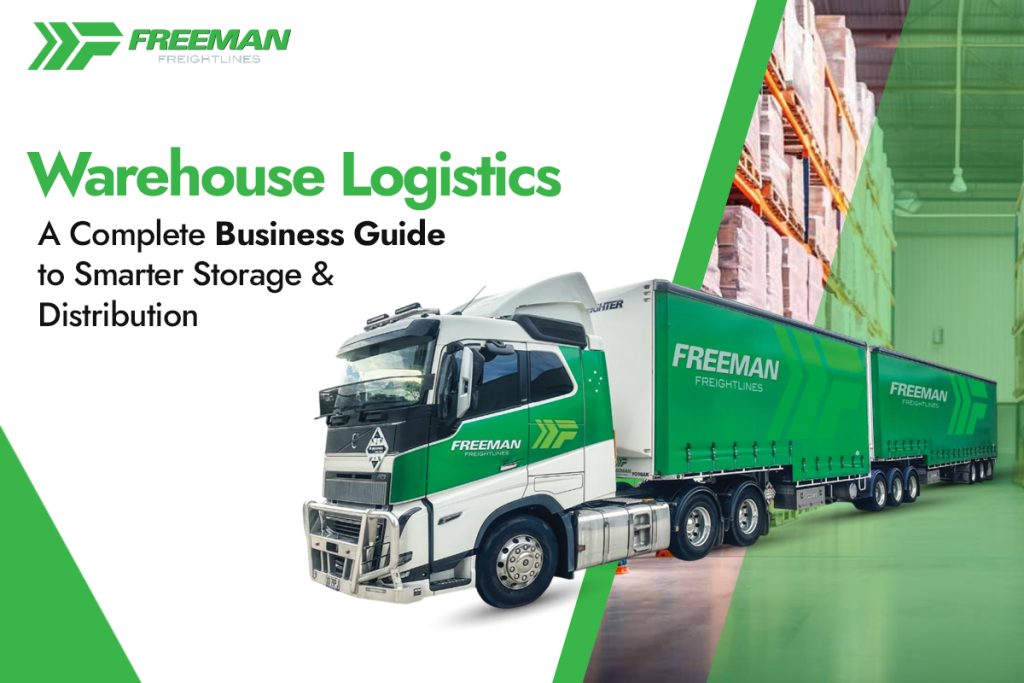
A fast-moving supply chain alone cannot guarantee management of retail stock, industrial freight, or national distribution. To make the logistics process smoother and more efficient, businesses need effective control and management of warehouse logistics. Effective warehouse logistics can enhance delivery performance, lower costs, and improve customer satisfaction.
This guide explains how modern warehouse logistics works, why it matters, and how it supports smarter freight management services across Australia.
What Is Warehouse Logistics?
Warehouse logistics is defined as the process of planning, coordinating, and carrying out every activity, such as receiving, storing items, selecting, packing, and sending them for further delivery. When done right, logistics are executed properly; they constitute the operational foundation of a business’s whole supply chain.
The Core Objectives Of Warehouse Logistics
Inbound Control
The process starts with a controlled and structured process. Freight is checked, verified, documented, and safely unloaded to prevent loss, damage, or stock discrepancies.
Optimised Storage Space
Modern warehouse logistics uses organised racking layouts, category zoning, and load-specific storage to protect goods while improving picking speed and space utilisation.
Inventory Management
Technology-driven stock tracking allows businesses to monitor quantities, movement, and turnover in real time. This visibility supports better purchasing, forecasting, and freight management services.
Minimise Lead Times
The goal of warehousing logistics is to guarantee that goods are available in the amounts and at the appropriate times to fulfil client demands and delivery schedules.
Product Safety
In order to prevent damage, theft, or loss, warehousing logistics is in charge of making sure that goods are stored safely and in accordance with safety standards and regulations.
The Functions Warehousing Logistics
- Products and materials entering the warehouse are received while their amount and quality are confirmed, and the information is entered into the inventory management system.
- Store goods effectively, making sure they are safeguarded and in the right conditions for preservation.
- The inventory management process keeps track of incoming and outgoing goods, health monitoring, managing stored product inventories, confirming stock, and producing inventory reports.
- Orders, product verification, product packing, and package labelling are all part of order preparation.
- Careful selection, preparation, management, and packaging with moisture, ventilation, and stability. Also confirms temperature and light control while warehousing and transporting live plant cartage.
- Organising the delivery of goods, whether via your own or a third-party vehicle, making sure they get to their destination on schedule and in the right way.
- Maintains tidy storage facilities and keeps them in good shape while making sure that health and safety regulations are sufficiently fulfilled.
The Major Types Of Warehousing Logistics
Traditional Warehousing Logistics
Traditional warehouse logistics focuses on the physical storage and movement of goods within a managed facility. It relies on structured racking systems, designated storage zones, and manual or semi-mechanised handling equipment to organise inventory.
This model suits general freight, retail stock, industrial supplies, and distribution-based businesses that require consistent, controlled stock management and reliable order fulfilment.
Automated Warehousing Logistics
Automated warehousing logistics uses advanced technology to streamline warehouse operations. This includes barcode scanning systems, automated conveyors, smart inventory software, and robotic handling solutions.
Automation improves picking accuracy, speeds up dispatch, reduces labour dependency, and supports real-time inventory tracking—making it ideal for high-volume distribution and fast-moving supply chains.
Temperature-Controlled & Cold Storage Logistics
Temperature-controlled warehousing is designed for goods that must remain within specific climate ranges. This includes fresh produce, pharmaceuticals, chemicals, and sensitive materials.
These facilities use refrigerated zones, insulated storage systems, and constant temperature monitoring to protect product integrity, safety, and compliance throughout the storage cycle.
High-Volume & Industrial Warehousing Logistics
High-volume warehousing logistics support the storage and handling of large-scale or heavy freight such as construction materials, manufacturing inputs, machinery, and bulk inventory.
These facilities are equipped with wide-access layouts, reinforced flooring, heavy-lift equipment, and large-capacity racking to accommodate oversized loads and continuous freight movement.
Live Plant Cartage & Horticultural Warehousing
Live plant warehousing is a specialised segment of warehouse logistics focused on the care, handling, and short-term storage of living plants. Unlike standard freight, plants require airflow, spacing, controlled environments, hydration management, and minimal handling.
This type of warehousing supports nurseries, growers, landscapers, and horticultural suppliers by maintaining plant health, reducing transit stress, and improving delivery outcomes.
The Modern Tech-Led Warehouse Logistics
Technology-led warehouse logistics are improved gateways that increase efficiency, control, and accountability. Apart from improving warehouse functionality, it also benefits the freight management services with accurate shipment data, traceability, and operational insights.
The technology-led warehouse logistics bring your business –
- Live inventory visibility
- Barcode and scanning accuracy
- Automated receipt and dispatch records
- Real-time stock movement reporting
- Integrated freight documentation
The Importance Of Warehouse Logistics In Modern Business
- Improved Inventory Control and Accuracy:
Warehouse managers can maintain ideal stock levels while preventing overstocking or stockouts thanks to efficient warehouse logistics, with real-time visibility into physical inventory levels. Businesses that use strong inventory management software report improvements in inventory accuracy of up to 99.5%, which dramatically lowers storage costs and raises customer satisfaction.
- Enhanced Productivity via Operational Efficiency:
Travel time within storage facilities can be reduced by up to 30% with optimised warehouse layout and procedures. Strategic positioning of high-demand commodities, effective use of warehouse space, and optimised warehouse procedures that do away with needless handling and movement are the causes of this improvement.
- Significant Cost Reduction:
Effective warehouse management lowers operating expenses in a number of ways. Enhanced efficiency lowers worker costs, better inventory control minimises carrying costs, and optimised storage lowers facility costs. After putting in place sophisticated warehouse management systems, Australian businesses usually experience a 10–20% decrease in operating costs within the first year.
- Increased Flexibility for Market Demand:
Companies can react swiftly to shifting consumer demand with well-managed warehouses. This adaptability enables businesses to take advantage of market opportunities, seasonally modify inventory levels, and sustain high customer satisfaction even in the face of demand swings.
- Enhanced Customer Satisfaction:
Accurate order fulfilment, quicker delivery times, and fewer errors are all directly correlated with efficient warehouse operations. Long-term revenue growth is facilitated by these enhancements, which raise customer satisfaction ratings and promote repeat business.
- Risk Management and Compliance:
Robust tracking systems that facilitate regulatory compliance, lower loss due to theft or damage, and offer thorough audit trails are all part of proper warehouse management. This all-encompassing approach to risk management guarantees operational continuity while safeguarding company assets.
FAQ
What is warehouse logistics?
The management of a business’s warehouse operations, from product receipt to distribution and sale, is the main focus of warehousing logistics.
What Is The Objective Of Warehousing Logistics?
The proper growth of a company’s supply chain is directly impacted by warehousing logistics. The optimisation of an organisation’s warehousing procedures is the primary goal of warehouse logistics, which has many different aims.
How does warehouse logistics improve freight operations?
By organising freight before transport, warehouse logistics reduces loading time, improves consolidation, and supports smoother freight management services.
Is warehouse logistics only for large businesses?
Businesses of all sizes benefit from structured warehouse logistics, particularly those managing regular freight, growing inventory, or multi-location distribution.
Can warehouse logistics reduce operational costs?
Efficient warehouse logistics lowers labour, storage waste, handling damage, and freight inefficiencies.
What industries rely most on warehouse logistics?
Retail, manufacturing, construction, agriculture, healthcare, and e-commerce all depend heavily on professional warehouse logistics and integrated freight management services.
End Note
Are you looking for trusted warehouse logistics with freight management services? Freeman Freightlines delivers integrated warehouse logistics and freight management services designed for Australian businesses that demand consistency, visibility, and control. With purpose-built facilities, modern inventory systems, specialised handling capabilities, and a transport-backed logistics network, Freeman Freightlines supports every stage of your storage and distribution process.
If your business is ready to upgrade its warehouse logistics and streamline freight movement, Freeman Freightlines offers the infrastructure, expertise, and reliability to move your supply chain forward.